Monstrosity, Bodies, and Borders: Figurations of the Double in Jordan Peele’s Film Us
Abstract
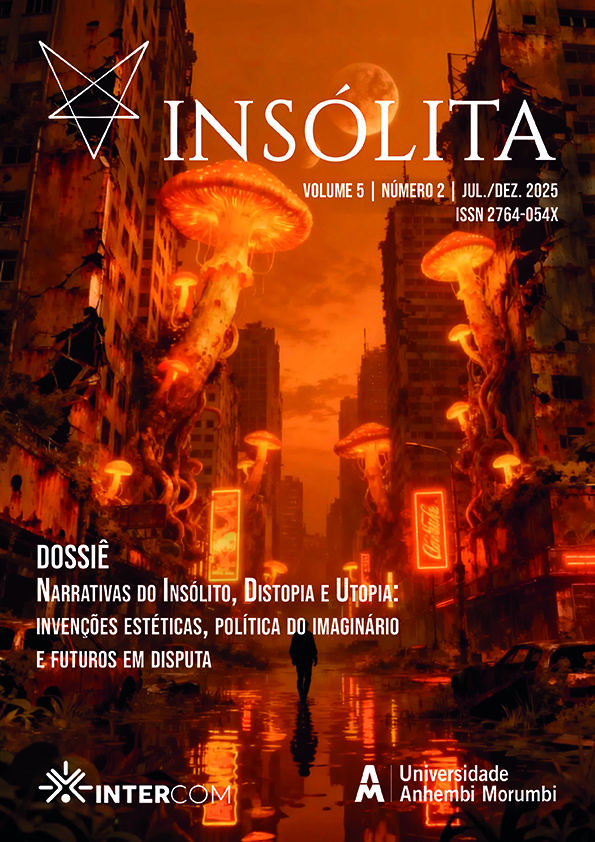
This article analyzes Jordan Peele’s Us (2019) through the figure of the double as an aesthetic and political operator of dystopia. In dialogue with Who Sings the Nation-State? by Judith Butler and Gayatri Spivak, it investigates how the pronoun “us,” inscribed in the film’s title, destabilizes naturalized notions of national belonging. The narrative projects into the present the ruins of liberal democracy, exposing physical and symbolic borders that produce “stateless” subjects within the nation. Drawing as well on Clément Rosset’s reflections on illusion, duplication, and the refusal of the real, the article reads monstrosity as an effect of the emergence of the excluded and of the collapse of utopian promises of unity. By recuperating the event Hands Across America as an anti-utopian parody, the film transforms the imaginary of national cohesion into an image of collective violence. The uncanny thus operates as a critique of the present, revealing dystopia not as a distant future but as a structural condition of the now.
Downloads
Published
Issue
Section
License
Copyright (c) 2026 INSÓLITA - Revista Brasileira de Estudos Interdisciplinares do Insólito, da Fantasia e do Imaginário

This work is licensed under a Creative Commons Attribution-NonCommercial 4.0 International License.
A INSÓLITA está licenciado com uma Licença Creative Commons Atribuição-NãoComercial 4.0 Internacional. Os Direitos Autorais dos artigos publicados na INSÓLITA pertencem ao(s) seu(s) respectivo(s) autor(es), com os direitos de primeira publicação cedidos à Revista. Toda vez que um artigo for citado, replicado em repositórios institucionais e/ou páginas pessoais ou profissionais, deve-se apresentar um link para o artigo disponível no site da INSÓLITA. Os artigos publicados são de acesso público, de uso gratuito, com atribuição de autoria obrigatória, para aplicações de finalidade educacional e não-comercial, de acordo com o modelo de licenciamento Creative Commons adotado pela revista.