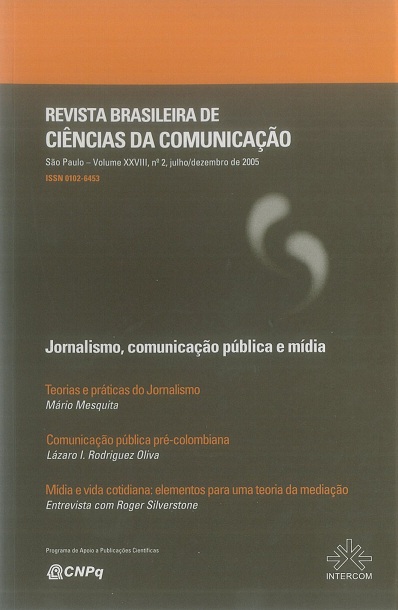
Mídia e vida cotidiana: elementos para uma teoria da mediação
DOI:
https://doi.org/10.1590/rbcc.v28i2.386Abstract
Resumo O objetivo principal da entrevista com o professor Roger Silverstone é aprofundar algumas questões referentes ao estudo da mídia na vida cotidiana, especialmente a partir de dois de seus livros - Television and everyday life (1994) e Why study the media? (1999) - que têm em comum a proposição de conceitos e noções com vistas í sedimentação de uma teoria da mediação que inclua a mídia e a circulação do sentido. Há também uma breve referência a sua pesquisa atual sobre a produção e consumo midiático por grupos minoritários.Palavras-chave: experiência, consumo midiático, vida cotidiana.
Resumen El objetivo principal de la entrevista con el profesor Roger Silverstone es profundizar algunas cuestiones referentes al estudio de la media en la vida cotidiana, especialmente a partir de dos de sus libros - Television and everyday life (1994) y Why study the media? (1999) - que tienen en común el planteo de conceptos y nociones con miras a la sedimentación de una teoría de la mediación que incluya la media y la circulación del sentido. Hay también una breve referencia a su investigación actual sobre la producción y consumo mediático por grupos minoritarios.
Palabras clave: experiencia, consumo mediático, vida cotidiana.
Abstract The main objective of the interview with professor Roger Silverstone is to develop more some issues regarding the study of media in everyday life, specially considering his two books - Television and everyday life (1994) e Why study the media? (1999) - which has in common the proposition of concepts and notions relating to establishment of a mediation theory that includes media and the spread of meaning. A brief reference to his present research concerning the production and media consumption by minority groups is also dealt with.
Keywords: experience, media consumption, everyday life.
Downloads
Published
2007-10-18
Issue
Section
Entrevistas - Diálogos Midiológicos
License
Copyright and Licensing PolicyRevista Intercom operates under an Open Access model. All journal content, including published articles, is licensed under a Creative Commons Attribution 4.0 International License (CC BY 4.0), unless otherwise noted.
- Copyright: Authors retain unrestricted copyright and full publishing rights to their work without restrictions.
- License to Publish: Authors grant Revista Intercom the right of first publication. Concurrently, the work is licensed under CC BY 4.0, which permits sharing, copying, distributing, displaying, and creating derivative works, provided the original work is properly cited and ownership is acknowledged.
- Self-Archiving: Authors are permitted and encouraged to deposit the published version of their articles (Version of Record) in institutional or thematic repositories immediately upon publication.
How to Cite
Mídia e vida cotidiana: elementos para uma teoria da mediação. Intercom - Brazilian Journal of Communication Sciences, São Paulo, v. 28, n. 2, 2007. DOI: 10.1590/rbcc.v28i2.386. Disponível em: https://revistas.intercom.org.br/index.php/revistaintercom/article/view/386. Acesso em: 25 aug. 2026.