The decentering of Cultural Imperialism: Televisa - ion and Globo - Ization in the Latin World
DOI:
https://doi.org/10.1590/rbcc.v16i1.808Keywords:
Imperialismo Cultural, Televisão, Influência, TeoriasAbstract
O modelo padrão no qual as indústrias de televisão se desenvolveram mundialmente nos anos 60 deu substância ao paradigma crítico durável do "Imperialismo Cultural", no qual os Estados Unidos enquanto nação foi visto como o centro a que penetrou culturas nacionais da maior parte do mundo através do sistema de televisão norte-americana e seus programas. Este artigo toma o paradigma do imperialismo cultural como ponto de referência contra o qual acessa tanto as mudanças nas influências culturais que são exercidas no mundo, como a maneira pela qual elas deveriam ser teorizadas.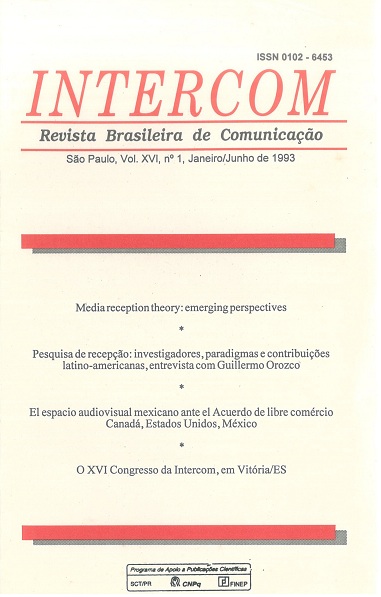
Downloads
Issue
Section
Articles
License
Copyright and Licensing PolicyRevista Intercom operates under an Open Access model. All journal content, including published articles, is licensed under a Creative Commons Attribution 4.0 International License (CC BY 4.0), unless otherwise noted.
- Copyright: Authors retain unrestricted copyright and full publishing rights to their work without restrictions.
- License to Publish: Authors grant Revista Intercom the right of first publication. Concurrently, the work is licensed under CC BY 4.0, which permits sharing, copying, distributing, displaying, and creating derivative works, provided the original work is properly cited and ownership is acknowledged.
- Self-Archiving: Authors are permitted and encouraged to deposit the published version of their articles (Version of Record) in institutional or thematic repositories immediately upon publication.
How to Cite
The decentering of Cultural Imperialism: Televisa - ion and Globo - Ization in the Latin World. Intercom - Brazilian Journal of Communication Sciences, São Paulo, v. 16, n. 1, 2012. DOI: 10.1590/rbcc.v16i1.808. Disponível em: https://revistas.intercom.org.br/index.php/revistaintercom/article/view/808. Acesso em: 28 aug. 2026.